The challenge
Selling through TikTok Shop rewards speed. Brands and creators need to know which products and videos are taking off, why they are working and who should promote what. Without a tool, that research means long stretches of scrolling, saving links, rewatching videos to note what was said, and testing ideas by trial and error.
The data exists, but it is scattered across products, affiliate videos and engagement figures that change constantly, and there is far too much of it to review by hand. The result is analysis paralysis: plenty of content to look at, and no reliable way to decide what to make next or which creator to work with. Analysis also has to keep up: by the time a trend has been spotted and discussed by hand, it may already be fading.
- Collect products, affiliate videos and metadata at scale
- Rank content by live engagement, not by whatever happens to appear in a feed
- Make video content easier to review and compare through transcription and ROI views
- Replace manual scroll-and-test loops with AI script generation and creator matching
What I built
I designed and built Viralzy in two halves: a Python data platform that collects and processes TikTok Shop content, and a Next.js product that presents it. Splitting them this way lets collection run in the background while the dashboards stay fast for the people using them.
On the data side, scrapers and workers collect products, fetch their affiliate videos and extract rich metadata at scale. Django provides the application layer, PostgreSQL holds durable storage, and Redis backs the queues that feed work to the workers. Queuing the collection work means a slow fetch does not hold up the rest, and capacity can grow by adding workers.
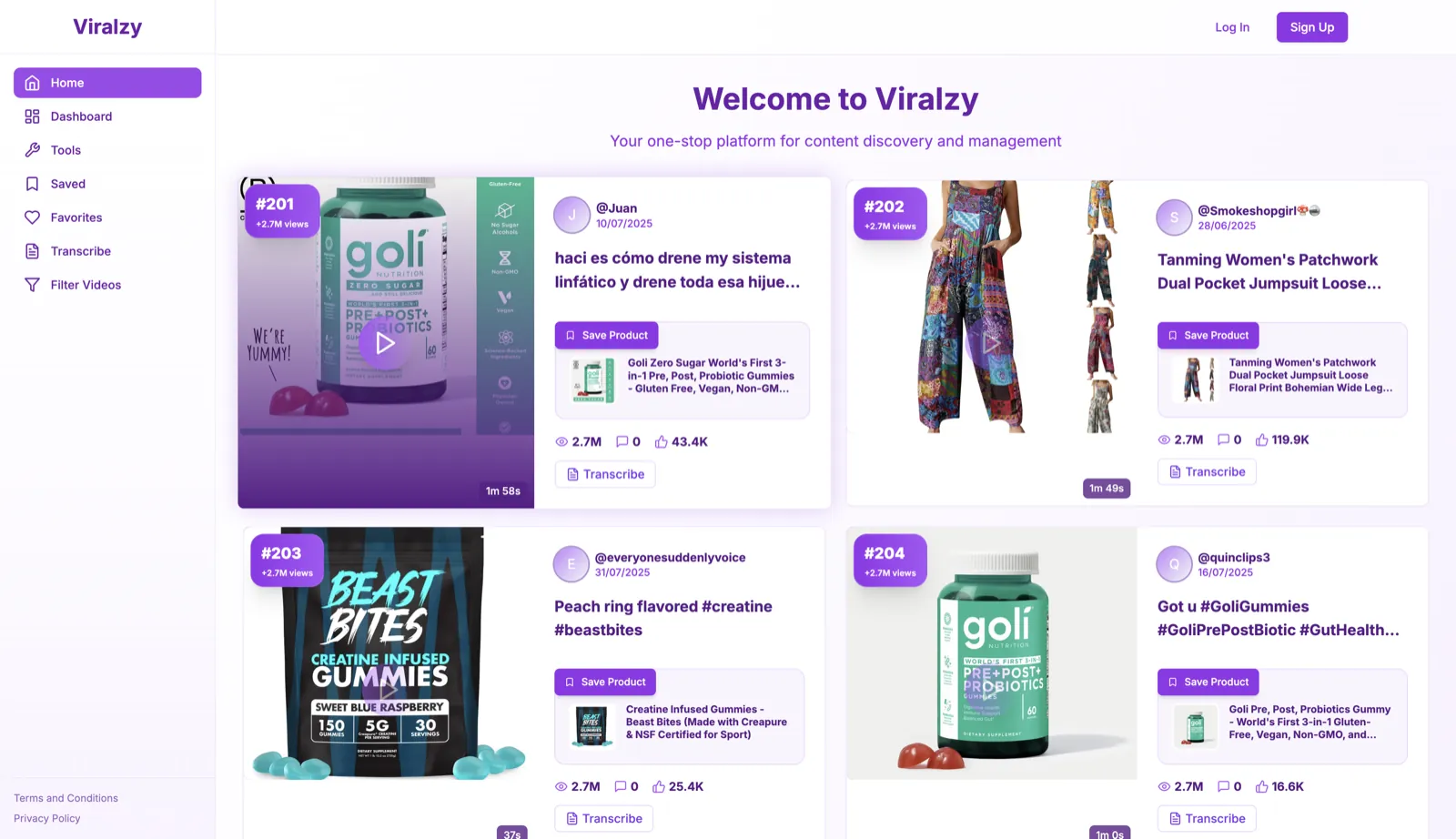
On top of that data, discovery feeds rank viral posts using live engagement signals, so users see what is performing now. Ranking by live signals matters because what is climbing now is more useful to act on than what peaked some time ago. Transcription turns videos into text that can be read and compared, and ROI views put performance alongside the content, reducing guesswork about what is worth following. Users can also save products to come back to.
The AI layer turns research into action. Script generation produces scripts for new content, and AI matchmaking pairs products with suitable creators, replacing the manual scroll-and-test loop. The front end is Next.js and React with TypeScript and Tailwind, rendering SEO-friendly dashboards.
- Scrapers and workers for products, affiliate videos and metadata
- Django, PostgreSQL and Redis for queues and durable storage
- Discovery feeds ranked by live engagement signals
- Transcription and ROI views
- AI script generation and product-to-creator matchmaking
- SEO-friendly Next.js and React dashboards
Architecture and stack
- Front end
- Next.js · React · TypeScript · Tailwind CSS
- Back end & data
- Python · Django · PostgreSQL · Redis
- Data collection
- Scrapers · Background workers · Queues
- AI
- Transcription · Script generation · Creator matchmaking
Outcome
Viralzy gives TikTok Shop teams one place to find viral affiliate content, see why it works and decide what to do next. Ranked discovery feeds, transcription and ROI views replace the scroll-and-save routine, and AI script generation and creator matching turn what the team finds into the next piece of content.
The effect is a move from analysis paralysis to repeatable content and creator workflows: the same process each time, built on collected data rather than on whoever happened to scroll past the right video. New team members can follow the same workflow instead of building their own research habits from scratch.
Behind the product, the queue-based collection pipeline keeps heavy scraping and processing apart from the user-facing app. That separation is what lets a data product like this take on more volume without the dashboards slowing down, and it is the first thing I check when reviewing any platform built on scraped or third-party data.
Last updated 2026-10-03